Skip Navigation

thyssenkrupp Steel is researching flexible and energy-efficient operation of industrial heating networks – in collaboration with the Niederrhein University of Applied Sciences (HSNR), the Institute for Energy Technology and Energy Management, and heatbeat nrw GmbH.

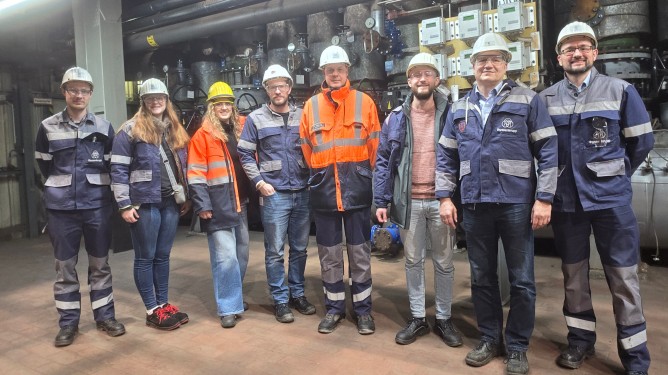
From left to right: Simon Möhren (thyssenkrupp Steel), Hannah Daldrup (SWK E²), Lisa Schmitt (SWK E²), Michael Mans (heatbeat), Stefan Saalberg (thyssenkrupp Steel), Maurice Görgen (SWK E²), Jörg Meyer (SWK E²), Christian Schäfer (thyssenkrupp Steel). Photo: Christian Schäfer

thyssenkrupp Steel Europe AG (thyssenkrupp Steel) is participating as a practical partner in the FlexHeatNet research project, which is being carried out by the Niederrhein University of Applied Sciences (HSNR) together with the SWK E² Institute for Energy Technology and Energy Management and heatbeat nrw GmbH.

The aim is to use modern modeling and optimization methods to make industrial heating networks more flexible, energy-efficient, and climate-friendly. The project is funded by the state of North Rhine-Westphalia and co-financed by the European Union.

As one of Germany's most energy-intensive companies, thyssenkrupp Steel has been working for years to increase energy efficiency and transform its production to be climate-neutral. A key lever in this effort is the optimization and decarbonization of industrial heat supply systems. “Heat networks play a central role in our plants in providing space and process heating,” explains Stefan Saalberg, Head of District Heating, Steam and Waste Heat Utilization at thyssenkrupp Steel.

The core of the project is the development of a digital twin of the heating network at the Duisburg-Hamborn site. This realistically maps flows, temperatures, and energy flows and is linked to an optimization model that evaluates the generation of heat, cooling, and electrical energy. On this basis, the project team is investigating flexibility options such as the use of heat storage systems, the integration of heat pumps, the use of additional waste heat sources, and the adjustment of central operating parameters.

The project started on October 1, 2025, with initial results expected in 2026.

Steel is contributing operating and grid data, examining the integration of additional waste heat sources, and evaluating control measures to increase the flexibility of heat consumers, generation capacities, and grid parameters. The provision of data has already been largely completed, and the investigation into the integration of additional waste heat sources has begun.

“The research project provides important insights for more efficient plant operation in an industrial environment in the context of climate-neutral production. By tapping into the potential for flexibility, energy costs can be reduced in times of high prices and CO2 emissions avoided beyond pure grid operation,” emphasizes Dr.-Ing. Simon Möhren, project manager at thyssenkrupp Steel. With this project, thyssenkrupp Steel will continue on its path toward climate-neutral production and also make a social contribution to security of supply at its Duisburg site.
Sponsor logos
To the top