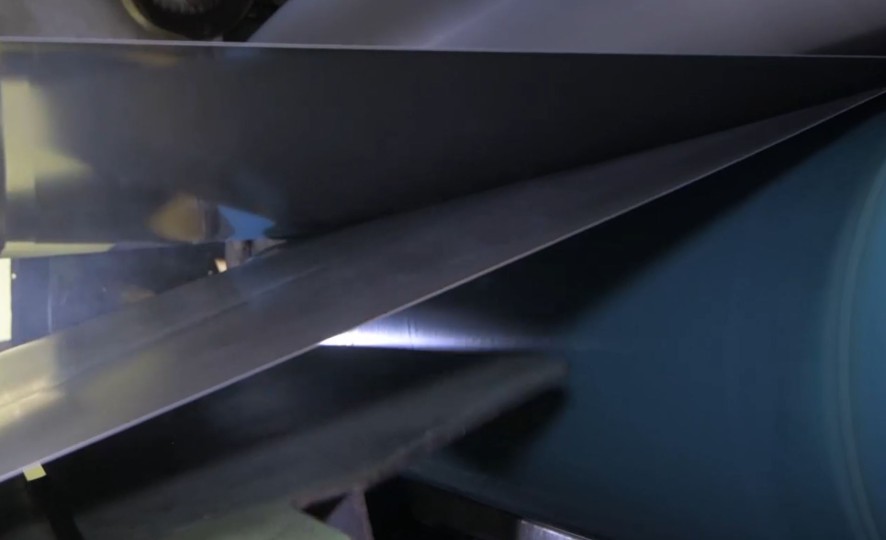
Applications of bondal®:
use in the field of electric mobility
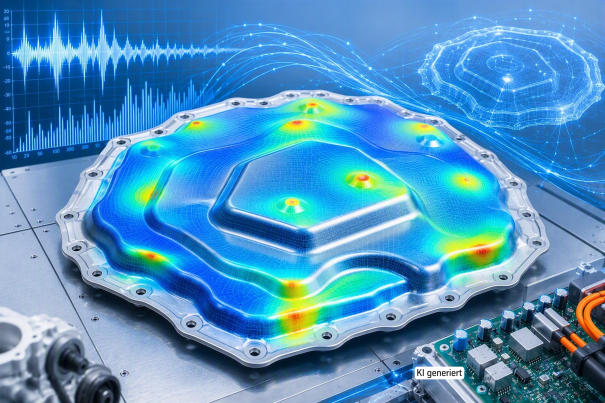
With its bondal® product, thyssenkrupp Steel is providing its customers with a sandwich sheet that features a visco-elastic polymer layer between two steel sheets. It is ideal for reducing noise in automotive construction, among other things. The latest application tests with the innovative sandwich sheet in battery vehicles also reveal considerable potential for optimizing the acoustics of electric drive motors and their power electronics. You can read more on the page structure-borne-damping composite material with customized properties.
Our technical press release on the use of bondal® in electric vehicles can be found here.
The steel-polymer composite bondal® also offers convincing advantages in other application fields – for example in noise abatement cabins, control cabinets, machine housings or shipbuilding: In addition to very good structure-borne noise damping, the sandwich sheet also offers good airborne noise damping in the formed condition. The composite material also has excellent EMC properties, particularly electromagnetic shielding, and consequently high electromagnetic compatibility. Not only does the sandwich material actively counteract sound propagation and vibration, it also scores highly in terms of thermal insulation. Just like monolithic steel, the material can be recycled easily.
bondal® CB40: Structure-borne sound absorption and airborne sound insulation with certified fire protection
R1/HL3 tested in accordance with DIN EN 45545-2: meets the requirements for the highest hazard level in rail vehicle construction
bondal® CB40 combines effective structure-borne sound absorption and airborne sound insulation with certified fire performance. The certified version, with a nominal thickness of 1.04 mm and a galvanized surface without an organic coating, meets the R1 requirement set for hazard level HL3 in accordance with DIN EN 45545-2:2023-12.
HL3 is the highest hazard level in DIN EN 45545-2 and thus represents particularly high requirements for fire performance in rail vehicle construction. bondal® CB40 combines these requirements with its acoustic properties, thereby offering a material solution for applications where fire protection, structure-borne sound insulation, and airborne sound insulation are equally essential.
Test results
| Test standard | Parameter | Unit | Result | HL3 criterion |
|---|---|---|---|---|
| ISO 5658-2 | CFE | kW/m² | 50.0 | ≥ 20 |
| ISO 5660-1, 50 kW/m² | MARHE | kW/m² | 1.0 | ≤ 60 |
| EN ISO 5659-2, 50 kW/m² | Dₛ(4) | – | 0.6 | ≤ 150 |
| EN ISO 5659-2, 50 kW/m² | VOF₄ | min | 1.4 | ≤ 300 |
| EN 17084, Method 1, 50 kW/m² | CIT G | – | 0.01 | ≤ 0.75 |
The tested product configuration is documented in test reports 8125401863-100a, 8125401863-100b and 8125401863-100c. The tested bondal® CB40 configuration had a nominal thickness of 1.04 mm and a zinc-coated surface with no organic coating.
Sandwich sheet with visco-elastic polymer intermediate layer
| Steel grade designation | Standard designation | THICKNESS1 from _ to in mm |
WIDTH1 from _ to in mm |
|---|---|---|---|
| bondal® CPT | Special mill grade | 0.5 – 1.0 | 600 – 1,480 |
| bondal® CB40 | Special mill grade | 0.5 – 1.0 | 600 – 1,480 |
Coatings
| SURFACE FINISHING | ||||||||
|---|---|---|---|---|---|---|---|---|
| Steel grade designation | Standard designation | -/UC | ZE/EG | Z/GI | ZF/GA | ZM | AS | ZA |
| bondal® CPT | Special mill grade | |||||||
| bondal® CB40 | Special mill grade | |||||||
1 Not all thickness and width combinations possible
available
-/UC: Uncoated
ZE/EG: Electrolytically galvanized
Z/GI: Hot-dip galvanized
ZF/GA: Galvannealed
ZM: ZM Ecoprotect®
AS: Aluminium Silicium Coated